← All work

SummariT&C: the fine print, finally clear.

A Chrome extension that spots terms and conditions while you browse, translates them into plain language, and shows you what deserves a second look, right at the moment before you click “I agree.”

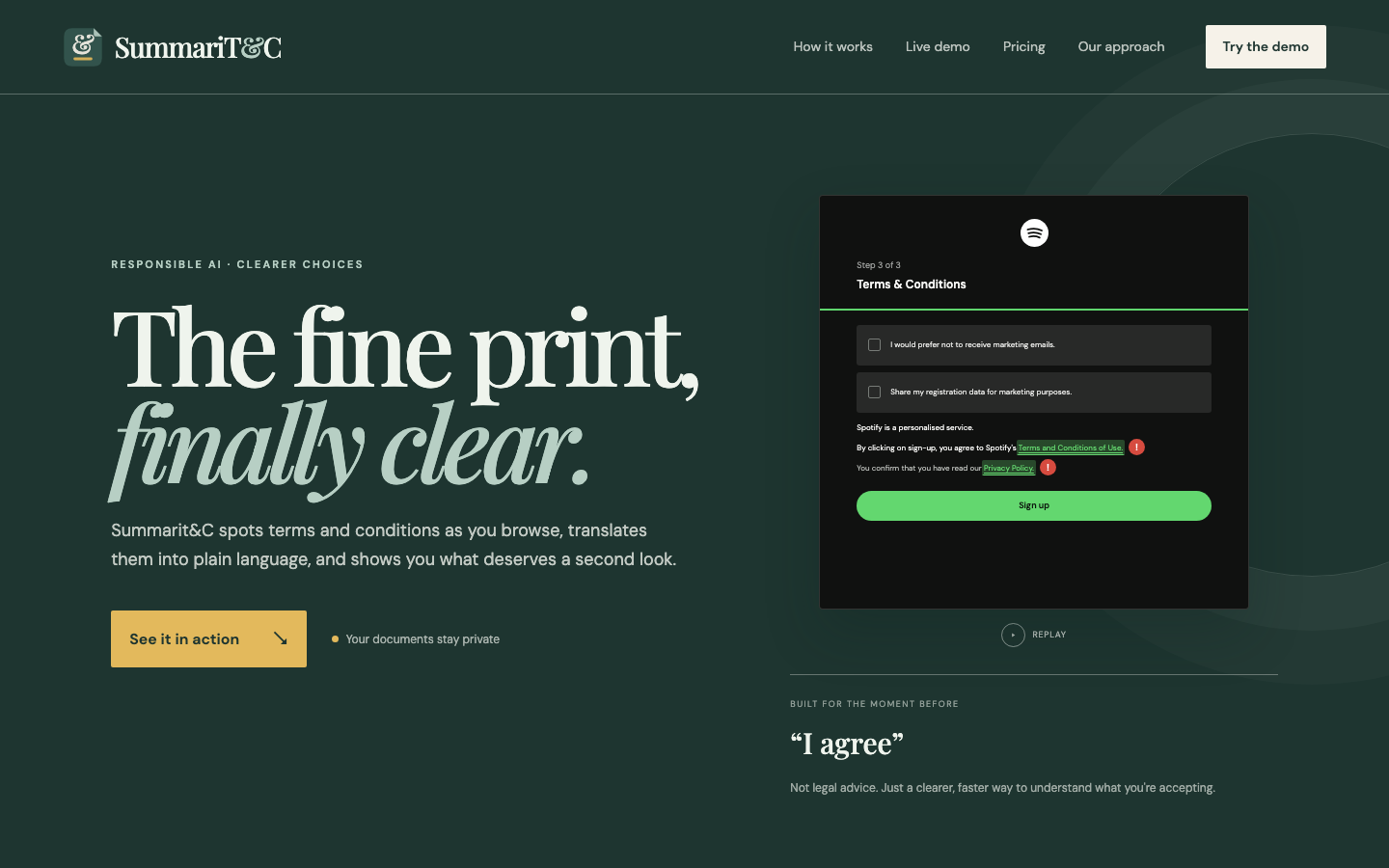
SummariT&C website hero: 'The fine print, finally clear.' next to a Spotify sign-up form where the terms and privacy policy links are flagged

My role

Founder, product designer & developer. My idea, designed and built from the ground up.

Timeline

2023 to present. Redesigned in Fall 2026.

Context

Personal project, and my Digital Disruption & Innovation project at the University of Hull.

Tools

Figma, Figma Make, React, TypeScript, Chrome Extensions, OpenAI API

Everyone clicks “I agree.” Almost no one reads.

Terms and conditions are long, dense, and written by lawyers for lawyers. So people skip them, and without knowing it they agree to things like subscriptions that renew forever, their data being shared for marketing, or giving up the right to take a company to court.

I noticed that a lot of people almost never read terms and conditions, and are unaware of what they’re truly signing up for. My research backed that up.

91%

of people accept legal terms and conditions without reading them. For 18 to 34 year olds, it’s 97%. Source: Deloitte, 2017 Global Mobile Consumer Survey (US)

How might we help people understand what they’re agreeing to, in the moment they agree, without asking them to read pages of legal text?
The first version, 2023.

I first designed SummariT&C in 2023. The core idea was there from day one: don’t make people go somewhere else to understand the terms. Meet them on the sign-up page, at the exact moment they’re about to agree.

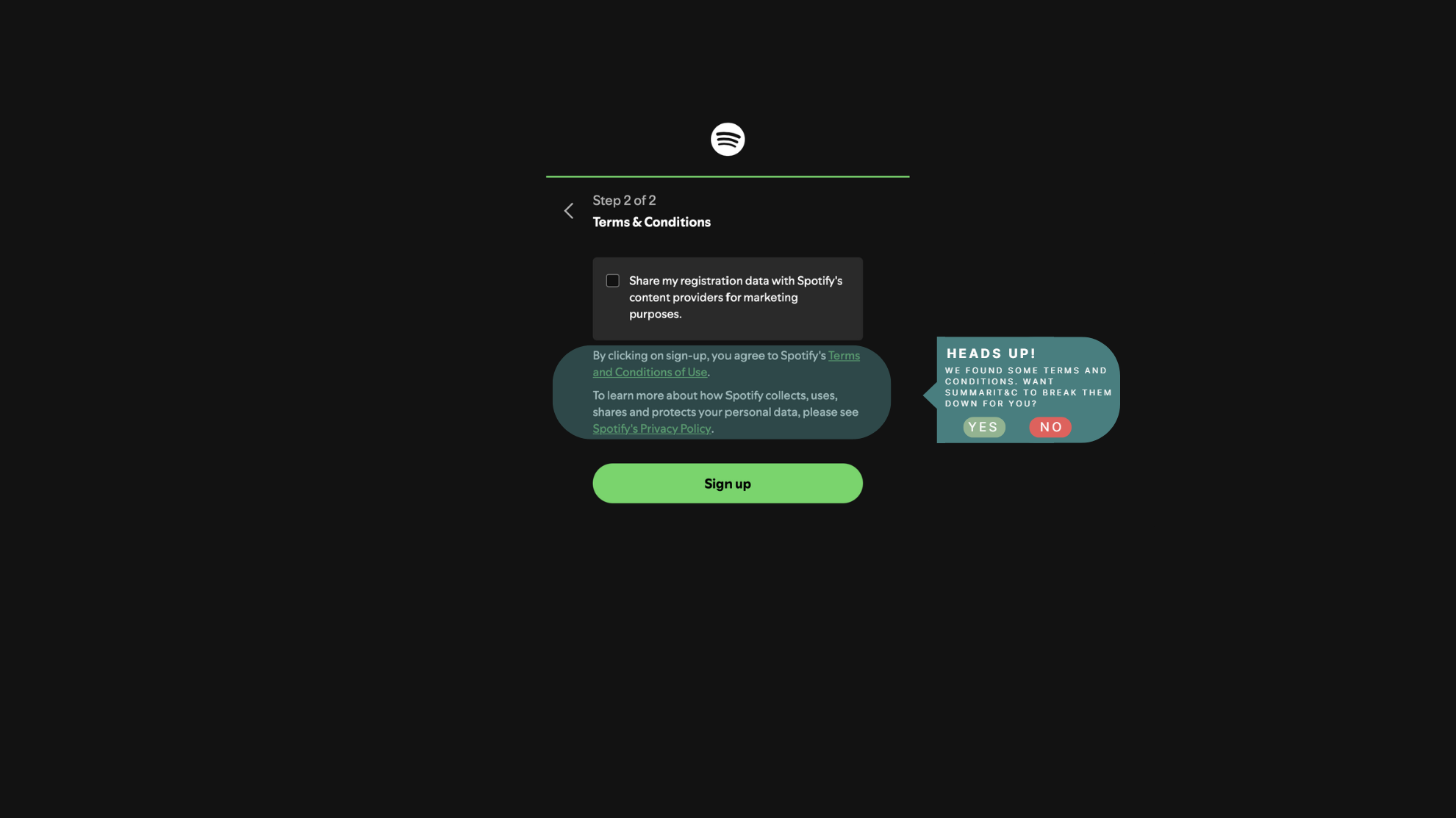
2023 design: a teal 'Heads up!' speech bubble next to a Spotify sign-up form, with YES and NO buttons
2023 in-page prompt. A “Heads up!” bubble appears beside the terms on a Spotify sign-up and offers to break them down.
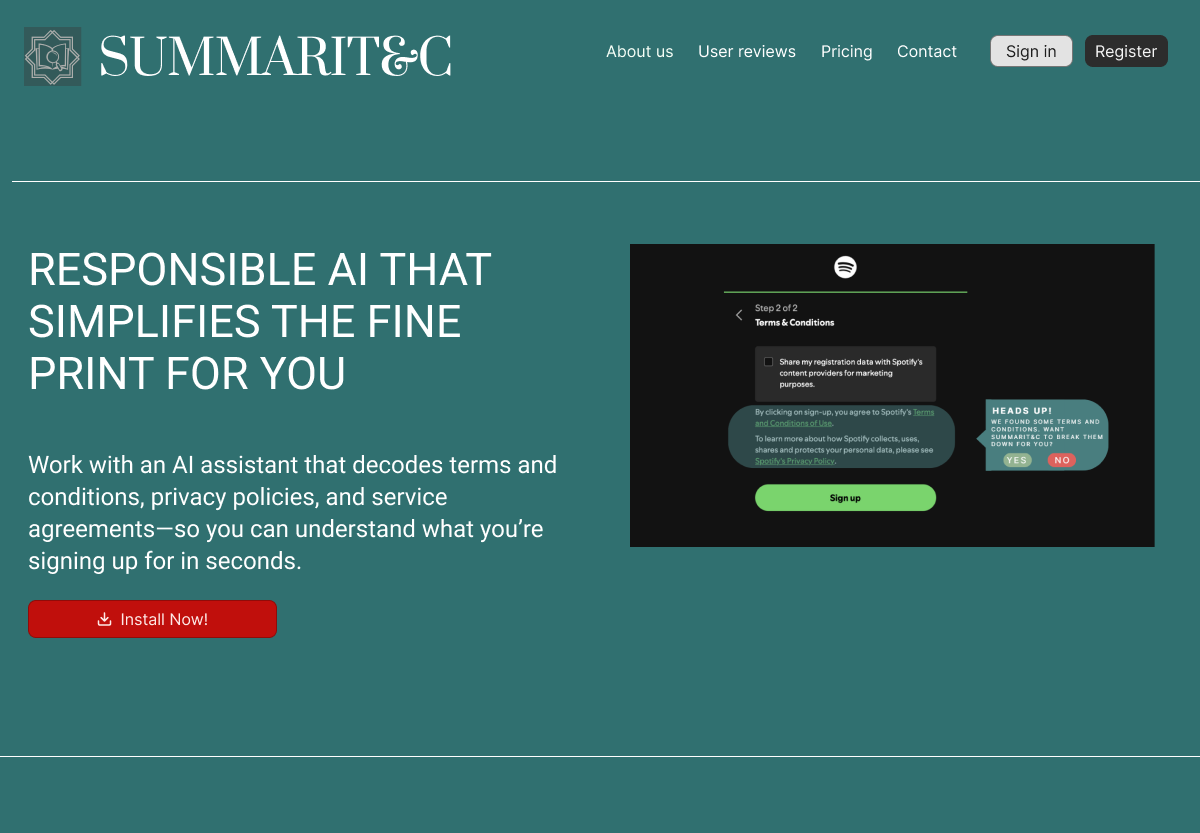
2023 landing page: teal background, all-caps headline 'Responsible AI that simplifies the fine print for you' and a red Install Now button
2023 landing page. “Responsible AI” was part of the pitch from the start.
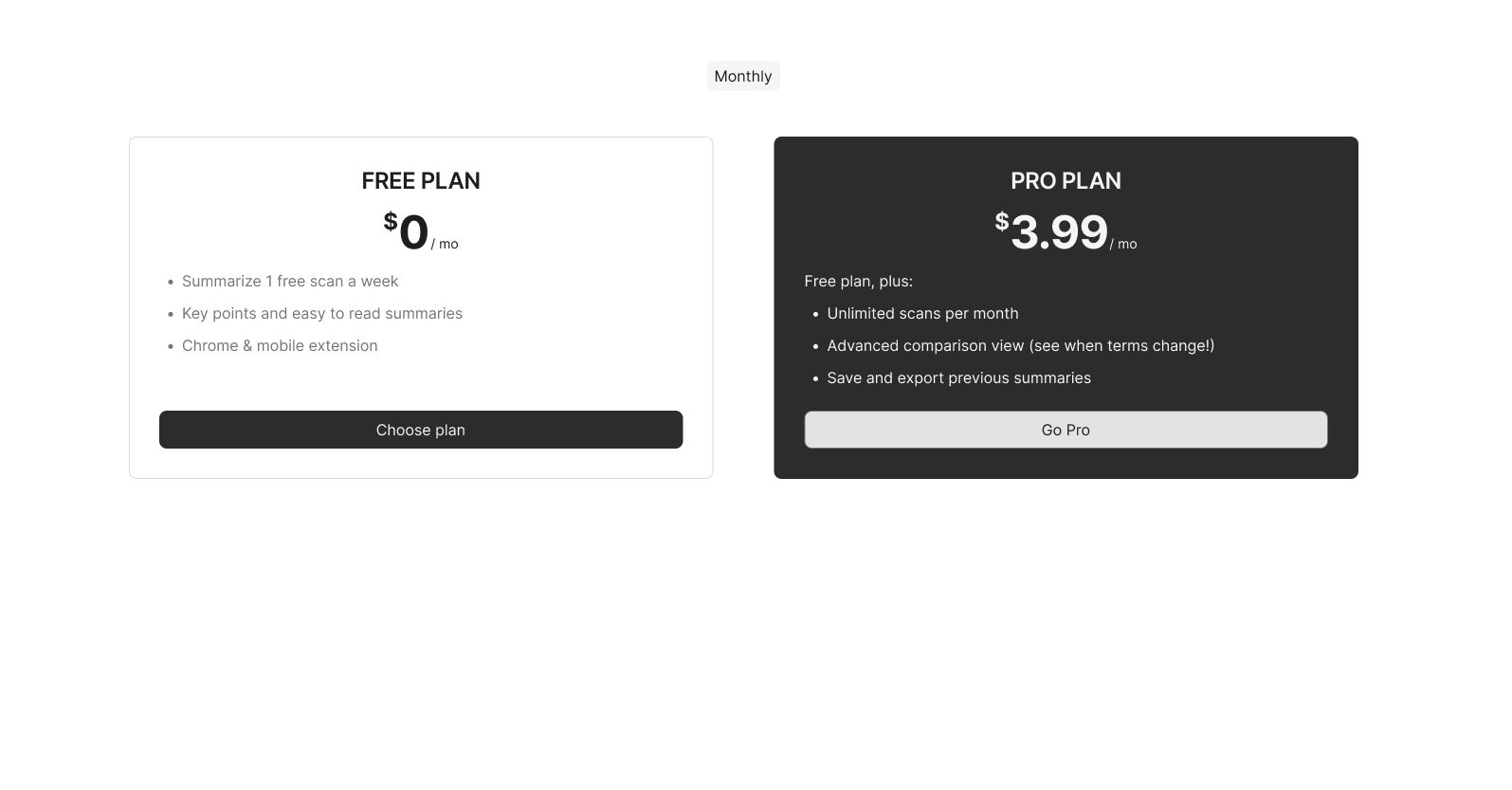
2023 pricing: Free plan at $0 with 1 scan a week, Pro plan at $3.99 with unlimited scans, a comparison view and saved summaries
2023 pricing. A free tier to build habit, and a Pro tier for people who sign up for a lot.

What worked

  • Showing up in context, on the sign-up page, not in a separate app
  • Asking before scanning, so the user stays in control
  • A clear freemium model and a trust-first “Responsible AI” message

What I wanted to fix

  • Tiny all-caps text in the prompt was hard to read, the opposite of the product’s promise
  • A red “No” button felt like an error, and “Yes / No” didn’t say what would happen
  • The landing page told people what it does with a static screenshot instead of showing them
  • The bright red install button clashed with the calm teal brand

Key design decisions.

In Fall 2026 I brought SummariT&C back as my Digital Disruption & Innovation project and redesigned it around one question: what would make someone actually trust an AI summary of a legal document?

01

Ask clearly, never assume

The prompt now names exactly what it found and what will happen next. Terms and the privacy policy each get their own marker, so people choose what to scan.

2023“HEADS UP! WE FOUND SOME TERMS AND CONDITIONS…” YES / NO
2026“We found Spotify’s Terms and Conditions in this sign-up.” Yes, scan it / Not now
02

A risk score, not just a summary

A summary still asks people to read and judge. A 0 to 100% risk score with a verdict like “Needs review” answers the real question first: should I worry about this? A short note explains the scale, so the number never feels like a black box.

03

Every claim links back to its source

People shouldn’t have to blindly trust AI with legal decisions. Tapping a flagged risk, like auto-renewal, scrolls to that exact clause in the real terms and highlights it. It works the other way too: clicking a flagged clause opens its explanation.

04

Plain language, then even plainer

Each risk has an “Explain it casually” button that opens a chat and explains the clause like a friend would. Suggested questions such as “Can I get a refund?” help people who don’t know what to ask, and every answer offers “Show me in the terms.”

05

Show, don’t tell

The landing page became the product demo. Instead of a static screenshot, visitors can click through a realistic Spotify sign-up and the full, real Spotify Terms of Use, and see the extension work on them.

06

Trust is a feature

A dedicated “Our approach” section says plainly how scanned terms are used: no data selling, no ad targeting, never used for training. And a small “Not legal advice” line sets honest expectations.

07

A calmer, more trustworthy brand

I moved from teal and red to deep green, sage, and a warm gold, with an elegant serif (Playfair Display) paired with a friendly sans-serif (DM Sans), plus a new ampersand logo mark. The goal: legal, but friendly.

Know before you agree.

The extension is fully working in Chrome (not yet published on the Chrome Web Store). The showcase site walks through the whole flow on Spotify’s real terms.

  1. DetectRecognizes terms and privacy policies on the page you’re on.
  2. TranslateTurns dense clauses into short, plain-language summaries.
  3. AssessGives a risk score and a list of what to be wary of.
  4. AskAnswers follow-up questions casually, with links to the source.
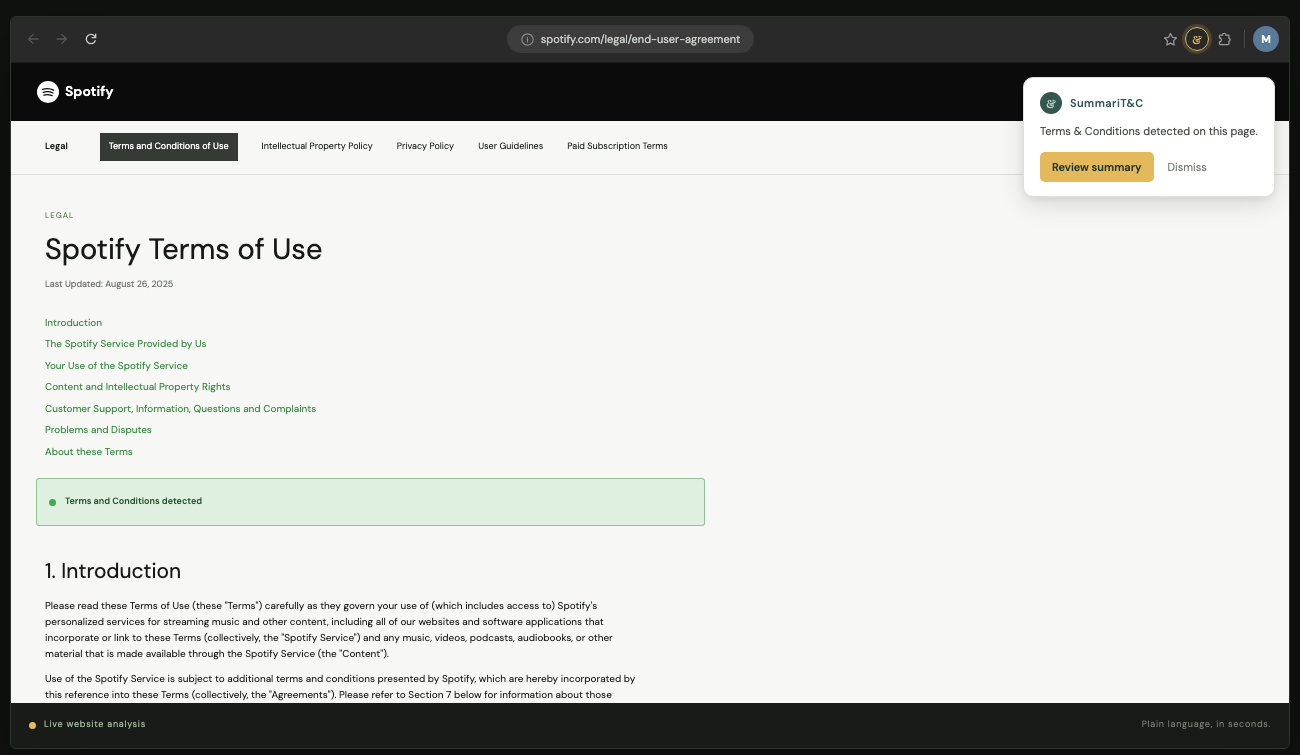
Interactive demo: a browser showing Spotify's Terms of Use, with a SummariT&C popup saying Terms & Conditions detected and a Review summary button
Interactive demo. SummariT&C detects Spotify’s terms and offers a summary, right inside the browser.
summaritc.pages.dev

Scroll inside the frame to “Know before you agree” and click “Review summary.” Or open it in a new tab.

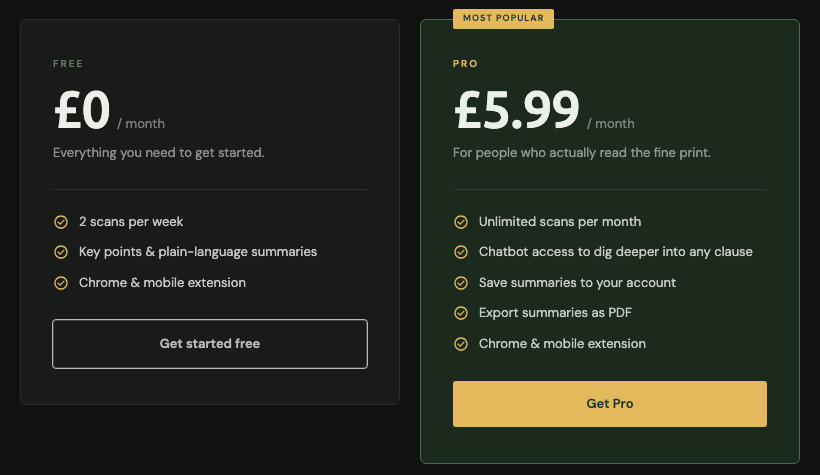
2026 pricing: Free at £0 with 2 scans per week; Pro at £5.99 with unlimited scans, chatbot access, saved summaries and PDF export
2026 pricing. The free tier went from 1 to 2 scans a week, and the chatbot became the main reason to go Pro.

Where it is today.

A working product

The Chrome extension runs end to end, from detecting terms to scoring and explaining them.

A live showcase

An interactive site that lets anyone experience the product without installing anything.

Three years of growth

The same core idea from 2023, redesigned with a much stronger focus on clarity and trust.

What I learned.

Designing AI is designing trust. The summaries were never the hard part. The real work was making people comfortable relying on them, which is why linking every claim back to the source clause became the heart of the redesign.

Real content beats placeholder content. Designing around Spotify’s actual terms showed me problems that fake text never would, like how long real clauses are and how much the risks vary.

What I’d do differently: document the process as I go. Between 2023 and now I made many decisions in my head and in quick iterations, and I wish I had saved more sketches, versions, and the reasons behind each change.

What’s next